What if EXXON is the Next NVIDIA? The Game Changer Nobody Sees Coming
XOM from #20 Back to Top 5 - and the $50B Canadian Giant Nobody's Watching


The Market Cap Dislocation: 32 vs 3
Market leadership always rotates. As Tech stocks are priced for growth that doesn’t exist, we can remember Technology is deflationary, and Cycles even when lengthy are Cycles.
Look at the top 35 market cap companies. Thirty-two sell software, ads, phones, or AI fantasies. Three own actual assets: Saudi Aramco, Exxon, Chevron.
Holding Reserves in the ground, these Scarce commodities serve critical infrastructure you simply can’t replicate.
As history shows, this gap between fake growth and real assets will close violently.
The EXXON Fall from Grace
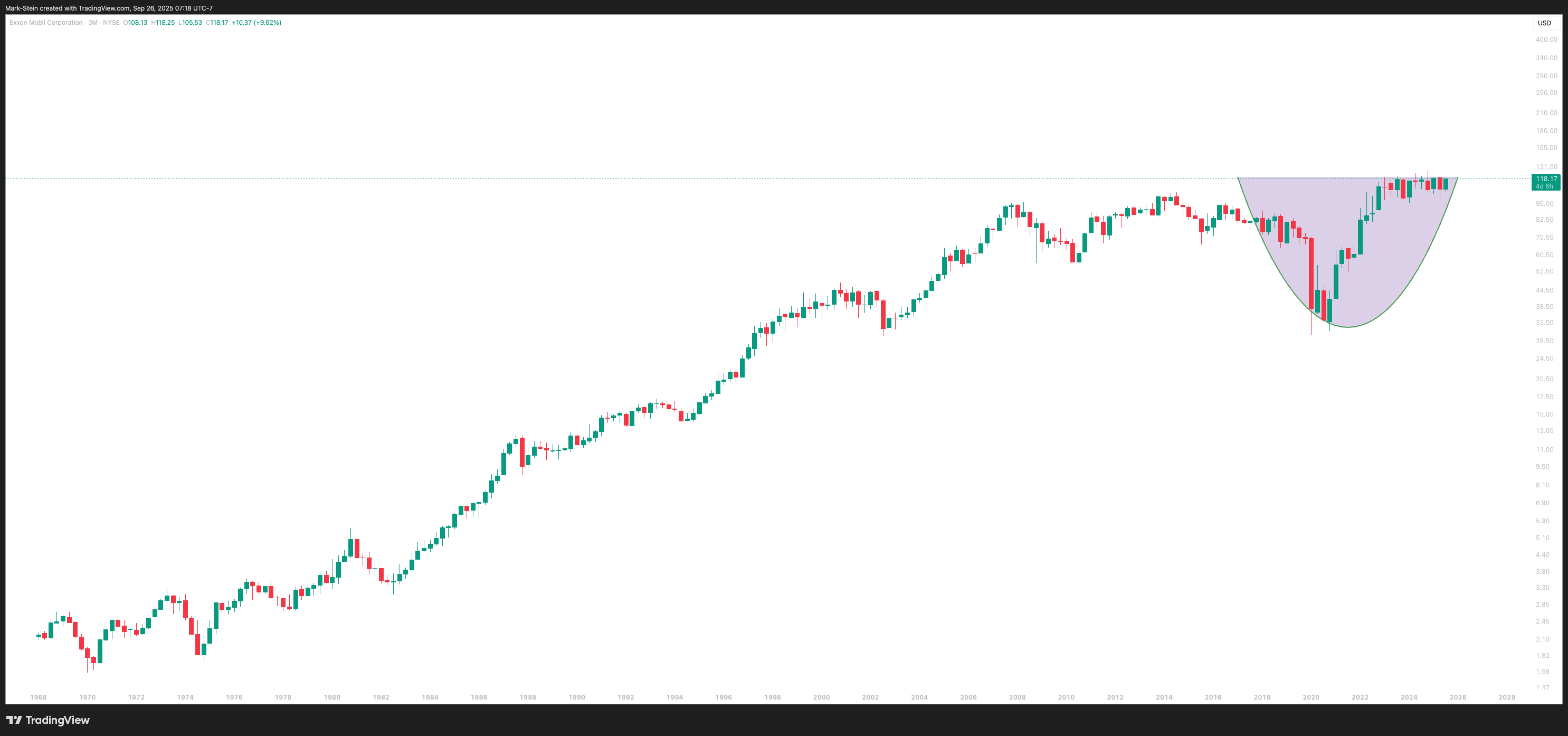
Exxon was in the top 5 market cap for decades. From the 2000s through 2010s—XOM was the blue-chip foundation of every institutional portfolio.
Today it’s #20.
And this is behind software companies, chipmakers, and many “growth” stories generating negative cash flow. The largest energy company on the planet—with irreplaceable global infrastructure and decades of reserves—trades like a forgotten dividend stock.
The market pricing mechanism is broken, giving us a unique opportunity.
The 1968-1981 Playbook
1968-1981: The S&P 500 went nowhere for fourteen years.
XLE, XLI, XLB tripled their market cap versus the index. Energy, industrials, materials—the real economy—led while growth stocks died.
Growth disappeared. The Nifty Fifty (IBM, Polaroid, Xerox) couldn’t deliver earnings priced into their multiples. When growth dies, capital rotates to scarcity.
We’re in 1966 right now. Maybe 1967.
Gold is already leading—the signal that paper assets are losing and hard assets are winning. Everything except SPX, NDX, Silver, BTC, and ETH is in a confirmed secular bear market versus Gold.
The secular rotation confirmation is 1-2 years away. The pattern is setting up exactly like it did before 1968.
Why Growth is Dead
Tech is deflationary by nature. Software margins approach 100%—prices collapse toward zero. Automation eliminates labor. Efficiency gains mean doing more with less.
AI makes everything faster, cheaper, more efficient. That’s the opposite of growth.
Markets are pricing NVDA, MSFT, and the Magnificent 7 for “AI-driven growth”—but AI’s entire purpose is reducing costs, compressing margins, and eliminating jobs. Where’s the GDP growth in that?
It’s not coming. Tech creates value through deflation, not expansion.
Governments are desperate for growth. They’re manufacturing it. Michael Howell sees it clearly: capital is being routed to the “real economy.”
The Inflation Reduction Act. The CHIPS Act. Defense spending surging. Infrastructure mandates. Reshoring requirements.
Capital is being forced into energy, manufacturing, commodities, and physical infrastructure because growth doesn’t exist anywhere else.
The rotation is already happening.
The Global Energy Crisis
US shale is in twilight. Sweet spots are drilling out, decline rates are accelerating, easy gains are over. Shale was never permanent—it was a short-term boom that’s fading.
Saudi Arabia has no incentive to raise output. They need $96+ oil to balance their budget (per IMF 2024 estimates).
With WTI currently at $57 and trending lower, the kingdom is managing production for higher prices, not flooding the market.
OPEC discipline is holding because every member needs revenue. Swing production to suppress prices is over.
Global energy investment has been starved for 15 years. ESG mandates, “energy transition” narratives, and political pressure killed capital deployment.
But demand isn’t cooperating with the peak oil 2030 fantasy.
The Perfect Storm We Created
The “energy transition” required solar/wind scaling up, nuclear building out, or some magical breakthrough.
Solar and wind? Intermittency is a physics problem, not an engineering challenge. You can’t run a grid on weather-dependent power without massive battery storage—and the economics don’t work at scale. Germany tried. Germany failed.
Nuclear? We destroyed it ourselves. Fukushima was a 1960s reactor hit by a once-in-generation tsunami. Actual radiation deaths: zero. Disaster-related deaths from evacuation: over 2,300.
The human response: NUCLEAR IS BAD. All of it. Everywhere. Forever.
One disaster, and we threw out the cleanest baseload power we had. The uranium supply chain collapsed, mining investment evaporated, enrichment capacity was mothballed.
Now AI data centers need massive power, and everyone suddenly wants nuclear again. Except the supply chain is broken. It’ll take a decade minimum to rebuild.
We’re stuck with hydrocarbons. Not by choice, but by elimination. We tried to transition away, politicized the alternatives, starved investment in the only thing that works, and created a supply crisis with no escape hatch.
The Commodity Supercycle Intensifies
Trade wars are back. Tariffs, export restrictions, economic nationalism are fragmenting global supply chains.
When countries can’t rely on global trade, they stockpile. When supply chains fracture, buffer stocks increase. When geopolitical tension rises, energy security becomes non-negotiable.
Commodities are entering a supercycle driven by deglobalization and underinvestment.
Gold is leading because it always leads the transition from paper assets to hard assets. It’s not predicting inflation—it’s confirming the regime change.
Hard assets are the only answer when growth is dying and governments are printing money to force activity in the real economy.
The Valuation Shift: P/E to NAV
When growth exists, markets use P/E multiples. Earnings growth justifies higher valuations.
When growth dies, markets shift to asset-based valuations. What do you own? What can’t be replicated? What’s scarce?
Exxon was valued on Net Asset Value (NAV) during the 1970s. Reserves in the ground, infrastructure you couldn’t rebuild, refining capacity that took decades to construct.
Then came the “shareholder value” era, and everything became about quarterly earnings and P/E ratios.
In a zero-growth, commodity-scarce, hard-asset regime? NAV comes back.
Exxon’s reserves aren’t just barrels of oil—they’re 40+ years of production from assets that can’t be duplicated. The infrastructure is sunk capital already paid for. The refining integration captures margins nobody else can access.
When the valuation method shifts back to assets, Exxon’s market cap doesn’t just recover—it explodes.
Why Exxon Specifically
Exxon is still the best.
Track record? Unmatched. Exxon has navigated every oil cycle, every political regime, every supply shock for over a century. When things got hard, Exxon adapted. When others collapsed, Exxon survived.
Capital allocation? The best in the business. Disciplined, shareholder-focused, ruthlessly efficient. No vanity projects, no ego-driven empire building.
Operations? Industry-leading. Exxon’s cost structure, safety record, and execution are the benchmark.
And now: Guyana.
Guyana is Exxon’s game-changer—offshore, lower cost, stable jurisdiction outside US political crosshairs. Over 11 billion barrels of recoverable reserves across 30+ discoveries, with production already at 660,000 barrels per day and targeting 1.3 million by 2027.
In oil, scale is the moat. You can’t disrupt Exxon’s global infrastructure. You can’t replicate their Guyana position. You can’t match their downstream integration.
Exxon isn’t competing—it’s dominating a commodity where supply is constrained and alternatives don’t exist.
The Passive Flow Catalyst
When Exxon moves from #20 back toward top 5, passive index funds are forced to buy.
Index funds weight by market cap. If Exxon is 1.5% of the S&P 500 at #20, but needs to be 3.5% at #5, they have to buy.
There’s over $13 trillion in passive index funds tracking the S&P 500.
A 2% weighting increase = $260 billion in forced buying.
That’s structural, mechanical, unavoidable buying pressure.
This happened with NVDA. As it climbed market cap rankings, passive funds had to increase exposure. The buying became self-reinforcing—higher prices forced more buying, which pushed prices higher.
Exxon doesn’t need to become NVDA’s size to trigger this. It just needs to reclaim its historical top 5 position. That alone creates a feedback loop of institutional buying that compounds the move.
The Chevron Question
Chevron at $297B is fairly valued.
Shell at $230B is facing European regulatory headwinds, energy transition pressure, defensive positioning. Good dividend story, limited upside.
Both are fine companies trading like fine companies.
Exxon at ~$490B (#20) has fallen from grace, and remains mispriced. The market treats it like a declining legacy business when it’s actually the best-positioned energy giant for the next decade.
For the NVDA parallel—the stock that becomes THE must-own—you don’t want consensus. You want dislocation.
Exxon is the dislocation.
The Asymmetric Canadian Alternative: Suncor
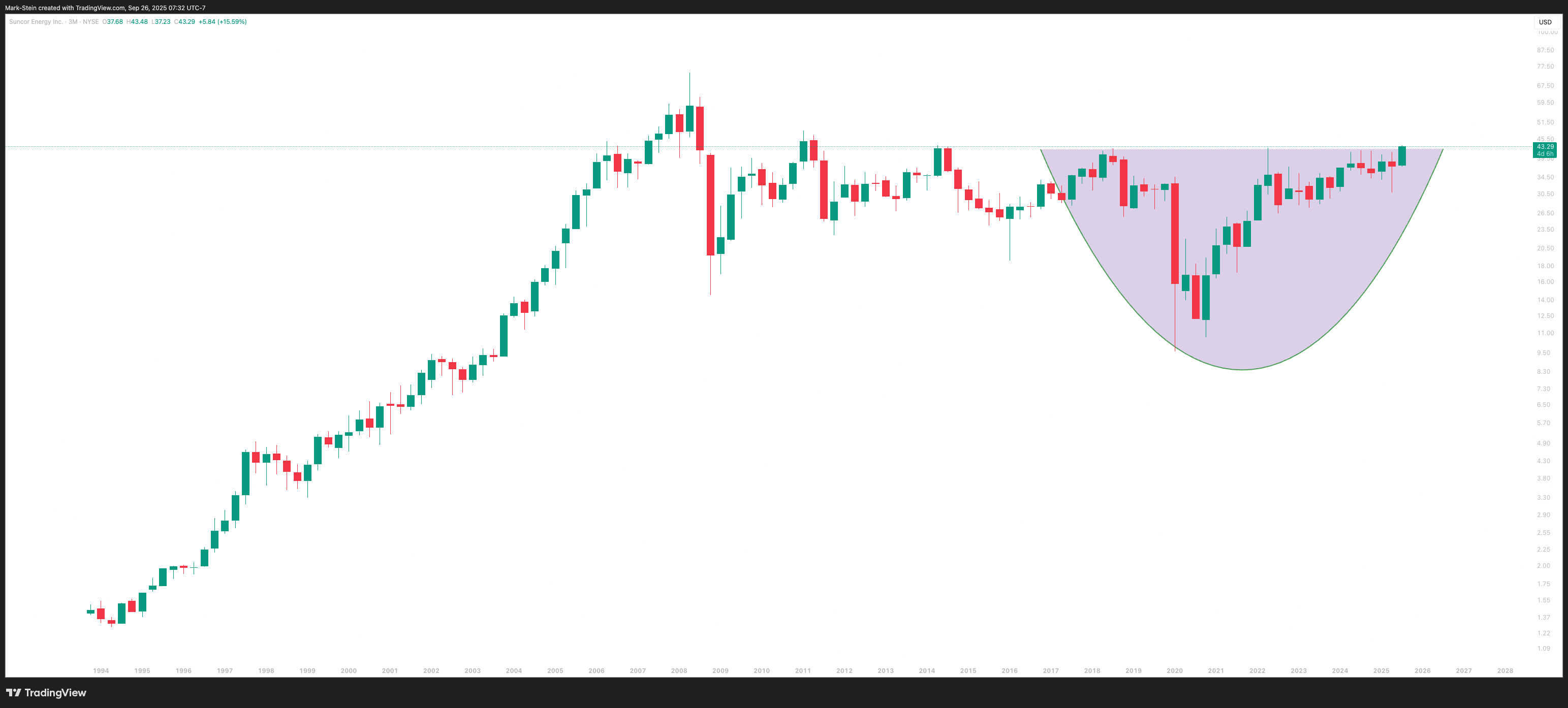
If Exxon is the NVDA of the next cycle globally, Suncor is the Exxon of Canada.
But with one critical difference: the asymmetry is even more extreme.
Exxon at ~$490B has room to double back to top 5. Institutional thesis—solid, mechanical, high probability.
Suncor at $55B? This is where the asymmetric opportunity lives.
Same regime change. Same NAV revaluation. Same transition from P/E multiples to asset-based valuations.
Suncor owns 40+ year oil sands reserves—irreplaceable infrastructure that can’t be built today at any price. The sunk costs are recovered. The breakevens are $30-40/barrel. The production is pure margin from here.
Suncor is the integrated Canadian giant. Syncrude (the crown jewel of oil sands). The institutional anchor for Canadian energy—the name that gets bought when capital flows north.
Technically? Breaking out of a 6-year cup and handle base right now.
Why Suncor Over Other Canadian Names?
Canadian Natural Resources? Excellent operator, great company—but it’s the pure-play alternative, not the integrated anchor.
Imperial Oil? Strong, but 69.6% owned by Exxon—you’re getting Exxon’s discipline with Canadian assets. If you own Exxon already, Imperial is redundant.
Suncor is THE name. The Canadian Exxon. The integrated giant with refining, retail (Petro-Canada), and the largest oil sands position.
When institutional capital rotates to Canadian energy, Suncor is where it goes.
The Asymmetry
Markets are pricing Suncor like Canadian oil sands are expensive, dying assets.
Reality: They’re the lowest-cost, longest-reserve-life energy infrastructure in North America.
Exxon reclaiming top 5 = a double, maybe 2.5x over five years. High probability, institutional-grade trade.
Suncor moving from $55B to $150-200B? That's 3-4x. Same thesis, same regime change—but from a radically lower basis.
You don’t need to choose. The trades complement each other:
Exxon = The global anchor, the institutional flow beneficiary, the must-own stock
Suncor = The asymmetric Canadian parallel, the 40+ year asset revaluation, the hidden giant
Regime Change
In the top 35 market cap companies, 32 are priced for growth that doesn’t exist. Three own real, scarce, irreplaceable assets.
We’re entering a 1968-1981 regime change where hard assets dominate and growth stocks stagnate for a decade.
Exxon isn’t chasing NVDA. It’s becoming the next NVDA—the defining stock of the era, the one institutions can’t not own.
Suncor? The asymmetric alternative. The Canadian parallel with even more upside from an even lower base.
The foundation is already shifting. Gold is leading. Government capital is flowing to the real economy. The valuation method is reverting to assets over earnings.
Exxon at #20 is the dislocation.
Suncor at $55 billion is the asymmetry.
The regime change is already here.
The regime change isn’t coming. It’s already here.
The value provided here is not some chatGPT shit. This gotta be hours of fk research and years of experience. If you get the chance to shortcut this by reading this, hit the like/restack/comments
Thanks again Mark!
Hey Guys - Seems like Many Liked this Theme, so here is Part 2
As well, getting lots of questions on Short vs Long-term Exxon, XLE, and Oil
As we were on top of the Coal Rotation, we'll update this Road Map shortly too.
https://substack.com/@markstein3/p-176335591